The Infrastructure Penalty: How Poorly Designed Handling Facilities Are Quietly Undermining Your Breeding Program
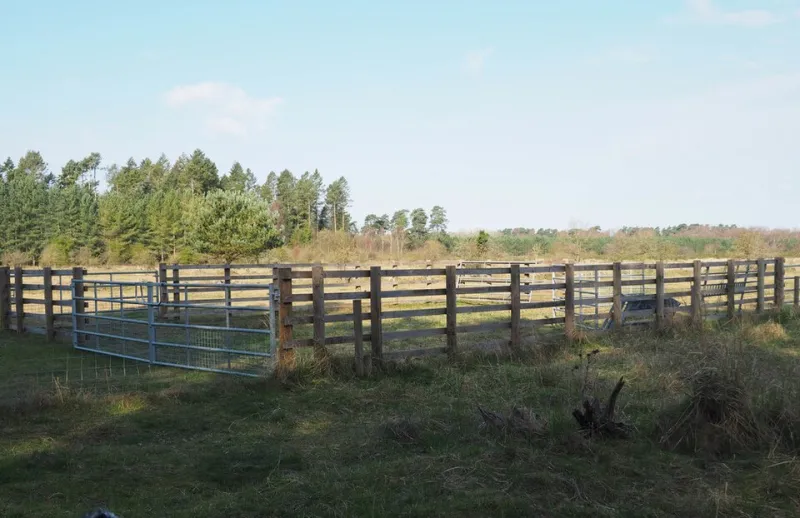
Photo: David Pashley , CC BY-SA 2.0, via Wikimedia Commons
A Problem Hidden in Plain Sight
The squeeze chute that takes three men and twenty minutes to run a single cow through. The alley that cattle balk at every time because of a shadow falling across the approach. The pen layout that requires animals to be pushed back through the herd to reach the working area. These are not merely inconveniences. They are physiological events with measurable consequences for your breeding program.
Stress responses in cattle — elevated cortisol, increased heart rate, and the cascade of hormonal disruptions that follow — do not resolve the moment an animal leaves the chute. Research from multiple university extension programs and the American Society of Animal Science has documented that acute handling stress can suppress reproductive hormone activity for days following the event. For cows in the critical window surrounding conception or early embryonic development, that suppression can mean the difference between a productive breeding season and an unexplained open rate that no nutritional adjustment will correct.
Yet when operations investigate poor conception numbers, facility design is rarely the first variable examined. It should be.
The Physiology of Stress and Reproduction
Cattle are prey animals with a well-developed stress response system. When that system is activated — by rough handling, disorienting facility layouts, excessive noise, or prolonged confinement in uncomfortable conditions — the body prioritizes survival functions over reproductive ones. This is not a behavioral quirk. It is a fundamental physiological response.
Cortisol, the primary stress hormone, directly suppresses luteinizing hormone (LH) and follicle-stimulating hormone (FSH), both of which are essential to normal ovarian cycling and embryo viability. Cows that experience repeated or prolonged stress events during the breeding season may exhibit delayed return to estrus, irregular cycling, reduced conception rates on first service, and elevated rates of early embryonic loss — all of which translate directly into fewer calves weaned and a lower return on your bull investment.
The bull side of the equation is equally relevant. Breeding bulls subjected to stressful handling can experience temporary reductions in libido and serving capacity. A bull that is agitated, sore from a poorly designed working system, or simply conditioned to associate handling with discomfort will not perform at his genetic potential during the breeding season. That underperformance is rarely attributed to the facility, but the connection is real.
Diagnosing Your Facility's Contribution to Reproductive Loss
Before investing in infrastructure upgrades, a systematic assessment of your current facility's stress profile is warranted. This evaluation should examine several dimensions.
Flow and movement patterns. Do cattle move through your working system with relative calm, or do they consistently balk, turn back, or require excessive pressure to advance? Resistance at specific points in the system almost always indicates a design problem — a sharp turn where a curved approach would work better, a change in footing that creates hesitation, or lighting conditions that create visual barriers cattle will not willingly cross.
Noise levels. Metal-on-metal clanging, high-pitched hydraulic sounds, and human shouting are all significant stressors. Facilities that generate substantial noise during routine processing are imposing a physiological cost that accumulates across every handling event in a season.
Time in the system. How long does the average cow spend from entering the working alley to being released? Extended processing times compound stress exposure. Efficient facility design reduces the time each animal spends under handling pressure, which reduces the cumulative hormonal impact.
Handler behavior patterns. Facility design and human behavior are interconnected. A poorly designed system that forces handlers to work harder and move faster inevitably produces rougher handling. Improving the physical layout often improves handler behavior simply by removing the frustrations that produce it.
Calculating the Return on Facility Investment
The financial case for facility upgrades rests on a relatively straightforward calculation, though gathering the necessary inputs requires honest record-keeping. The core variables are your current conception rate, your average calf value, and the improvement in conception rate that a well-designed facility can reasonably be expected to produce.
Research and field experience suggest that operations transitioning from high-stress to low-stress handling systems can expect conception rate improvements in the range of three to eight percentage points, depending on baseline conditions. For a herd of 150 cows with an average calf value of $850, a five-percentage-point improvement in conception rate represents approximately $6,375 in additional annual revenue — before accounting for reduced early embryonic loss, lower culling rates, and the extended productive life that results from reduced physical stress on breeding females.
When you also factor in reduced labor costs, lower veterinary expenses associated with handling-related injuries, and the improved longevity of cattle that are not subjected to chronic stress, the payback period for a well-planned facility upgrade is frequently shorter than producers expect. At LH Cattle Co., we encourage operations to approach this calculation with their actual production numbers rather than industry averages, as the specific return will vary considerably based on herd size, current performance, and the scope of the improvements contemplated.
Practical Upgrade Priorities
Not every operation requires a complete facility rebuild to achieve meaningful improvement. In many cases, targeted modifications to existing infrastructure produce substantial gains at a fraction of the cost of new construction.
Curved working alleys, where space permits, consistently reduce balking and improve cattle flow. Solid-sided alleys that prevent cattle from seeing distractions outside the working system are among the highest-return modifications available. Adjustable lighting to eliminate shadows in approach areas, anti-slip flooring in chute and alley areas, and hydraulic or mechanical assistance in the squeeze chute to reduce processing time all represent meaningful investments with clear physiological rationale.
For operations planning more comprehensive upgrades, engaging a livestock facility specialist with specific experience in low-stress handling design is strongly advisable. The principles developed through the work of researchers like Dr. Temple Grandin have been validated across a wide range of operation types and scales, and applying them correctly requires more than simply reviewing a diagram.
Infrastructure as a Genetic Investment
The genetics you have invested in — through careful bull selection, heifer development, and years of culling decisions — can only express themselves through animals that are physiologically capable of performing. A breeding program built on sound genetics but housed in a high-stress handling environment is operating at a persistent disadvantage that no amount of nutritional supplementation or veterinary intervention will fully overcome.
Viewing facility design as an extension of your genetic investment, rather than a separate operational expense, reframes the decision in terms that make the financial case considerably clearer. The infrastructure your cattle move through every season is either supporting or undermining the genetic potential you have worked to develop. Ensuring it does the former is not an optional refinement — it is a foundational requirement of a serious breeding operation.