Why Your Feed Program Isn't Fixing Your Weaning Weights — And What Actually Will
There is a conversation happening quietly across feedlots, sale barns, and kitchen tables throughout cattle country. A rancher adjusts his supplement program, upgrades his mineral blocks, and tightens his hay quality — yet his average weaning weight barely budges. A neighbor, running comparable country and a nearly identical ration, consistently weans calves thirty pounds heavier per head. The difference is rarely visible at the feed bunk. It is visible in the udder.
For a generation, the American cattle industry has been conditioned to think about efficiency in terms of feed conversion — pounds of gain per pound of feed consumed. That metric matters. But it captures only part of the performance picture, and for cow-calf operators focused on weaning weight as their primary revenue driver, it may not even be the most important part. The cow herself — specifically her genetic capacity to produce milk, sustain nursing, and transfer nutritional value to her calf during the pre-weaning window — is the variable that separates herds performing at ceiling from herds perpetually chasing it.
The Pre-Weaning Window Is Where Profit Is Built
Calves do not arrive at the scale as a product of your backgrounding program. They arrive as a product of everything that happened from birth to weaning — and the dominant influence during that period is the dam. Research has consistently demonstrated that a calf's access to high-quality maternal milk during the first 90 to 120 days of life has a profound and lasting effect on both weaning weight and subsequent performance. A cow that milks heavily and consistently raises a calf with a biological head start that no creep feed program can fully replicate.
Consider the arithmetic. A cow producing an additional two pounds of milk per day over a 180-day nursing period delivers roughly 360 additional pounds of liquid nutrition to her calf before weaning. At typical milk-to-gain conversion ratios, that volume translates to meaningful additional pounds on the scale — pounds that cost you relatively little beyond what the cow was already consuming to maintain herself. That is leverage. And it is the kind of leverage that compounds when you select for it deliberately across multiple breeding cycles.
Why Identical Rations Produce Different Results
The frustration ranchers feel when feed investments fail to move the weaning weight needle is understandable. The logic seems sound: better inputs should produce better outputs. But the cow is not a passive conduit. She is a biological processor, and her genetic makeup determines how efficiently she converts feed energy into milk and how consistently she delivers that milk to her calf.
Two cows on identical rations will partition nutrients differently based on their maternal genetics. A cow with superior milking genetics will preferentially direct energy toward milk production, sustaining lactation quality even under moderate nutritional stress. A cow with weaker maternal traits may maintain her body condition more readily but deliver less value to her calf — a trade-off that flatters your cow's appearance at the expense of your calf check.
This is the silent culprit behind weaning weight plateaus. Ranchers optimize the input side of the equation while leaving the conversion side — the cow's genetic capacity — largely unexamined.
Evaluating Females on Maternal Trait Profiles
The good news is that the tools to evaluate maternal genetics have never been more accessible. Expected Progeny Differences (EPDs) for milk are now standard across major breed associations, and genomic testing has made it possible to assess maternal potential in heifers before they ever raise their first calf. When building or refining a cowherd, these figures deserve the same scrutiny ranchers routinely apply to growth and carcass traits.
Milk EPD is not the only figure worth examining. Maternal Milk EPD — which accounts for the milk a bull's daughters will produce — should be a core criterion when selecting sires for replacement heifer production. A bull with strong growth numbers but weak maternal milk EPD may sire impressive feedlot steers while quietly degrading the milking ability of the daughters retained in your cowherd. That is a trade-off worth understanding before you write the check at the bull sale.
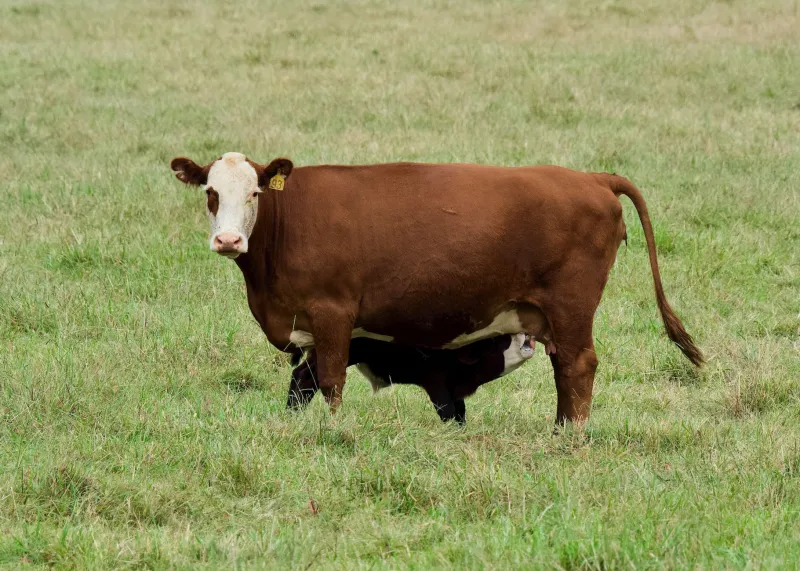
Beyond EPDs, direct observation remains irreplaceable. Udder conformation, teat size, and nursing behavior are heritable traits that affect how effectively a calf can access the milk a cow produces. A cow with a pendulous udder or oversized teats may technically have the capacity to produce adequate milk but fail to deliver it efficiently to a young calf. Udder structure is a functional trait, and it belongs on your selection checklist.
Building a Maternal Trait Framework for Your Operation
The ranchers who consistently wean heavy, uniform calf crops tend to share a common discipline: they evaluate their females as production units, not just as bodies in the pasture. A practical framework for incorporating maternal genetics into your selection process might include the following considerations.
First, establish a minimum Milk EPD threshold for any female retained or purchased as a replacement. What that threshold looks like will vary by breed and target market, but having a defined floor prevents the gradual erosion of milking ability that occurs when selection pressure is absent.
Second, cull females with documented nursing problems or structural udder defects regardless of their other performance metrics. A cow that raises a poor calf due to nursing failure is an economic liability, and those traits are heritable. Keeping her in the herd means selecting for the problem.
Third, track weaning weights by dam and review them annually. Cows that consistently wean calves below herd average despite comparable management deserve scrutiny. Some underperformance is attributable to circumstance — a difficult calving, a health event, a late breeding. But a pattern of below-average weaning weights is a maternal genetics signal worth heeding.
Finally, consider the generational dimension. The daughters of high-milking cows tend to be high-milking cows themselves. When you select aggressively for maternal traits today, you are not simply improving this year's calf crop — you are building a cowherd that compounds that advantage across every subsequent generation.
What the Scale Is Actually Measuring
At weaning, the scale is not measuring your feed program. It is measuring the cumulative effect of your cow's genetic capacity to nourish, sustain, and develop her calf from the moment of birth. Feed quality matters. Mineral balance matters. Health management matters. But all of those inputs flow through the cow, and the cow's genetics determine how effectively they are converted into pounds on your calves.
At LH Cattle Co., we have long held that the cowherd is the foundation of every profitable cattle operation. The bulls get the attention at sale time, and rightfully so — sire selection shapes the next generation. But the cow is the engine of daily production, and her maternal genetics are the single most underutilized lever available to most cow-calf operators in America today.
Breaking through a weaning weight plateau is not a feed problem. It is a genetics problem. And genetics, unlike feed costs, can be improved permanently — one well-selected female at a time.